

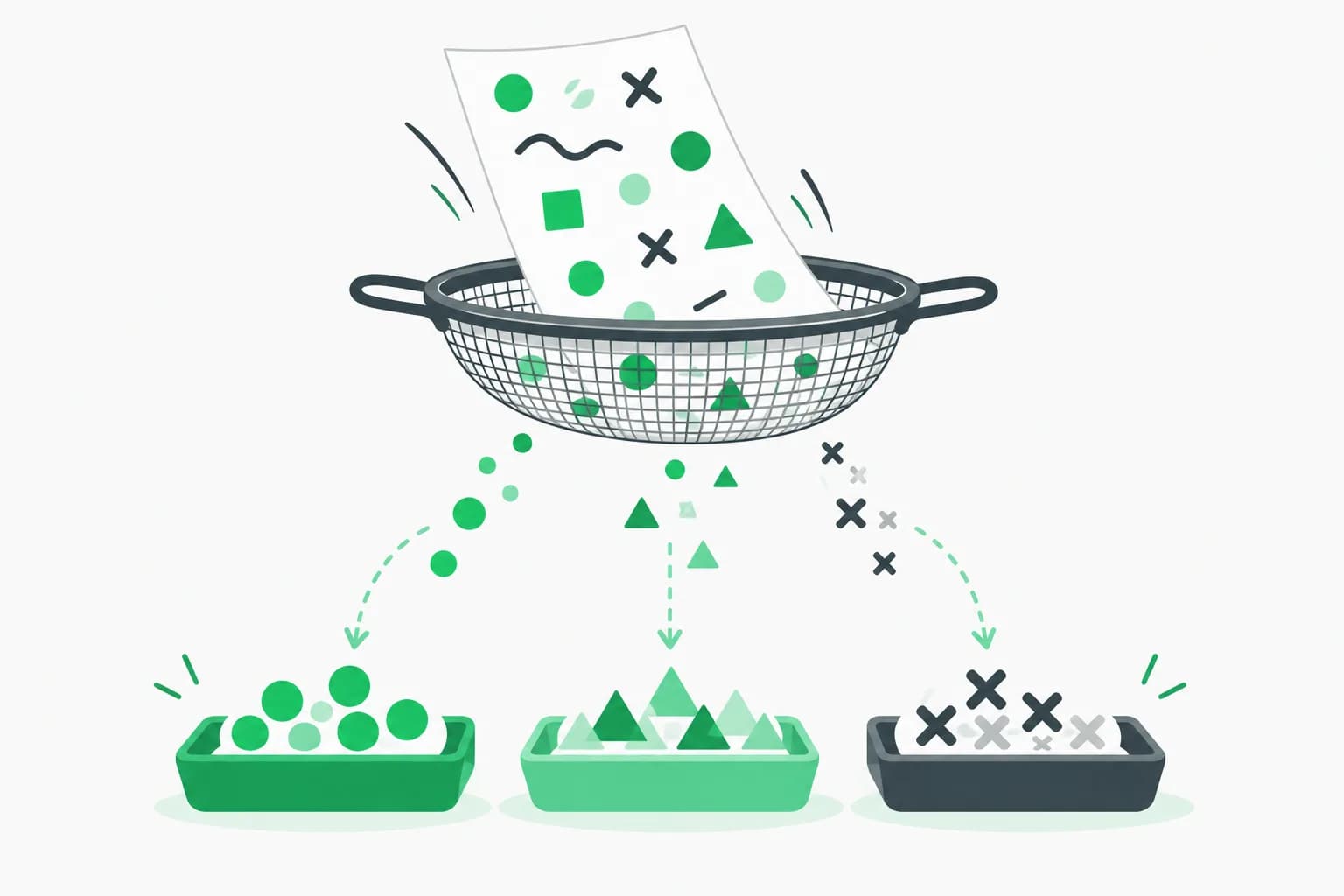

A failed test becomes useful when you identify the cause of each mistake. Start with the paper and the corrected version, then turn your observations into small, checkable tasks. Rereading the whole chapter without knowing why you lost points risks repeating the same work.
Wait until you understand the correction
Read the comments with the original question in front of you. Separate the overall grade from specific problems: missing knowledge, incorrect application, ignored instructions, missing justification, or an unfinished answer.
If a comment is unclear, prepare a precise question for the teacher. “What should have been added to justify this step?” gets a more useful answer than “Why is my grade low?”
Before the holidays, do this sorting on one paper. The official 2026-2027 calendar can help you schedule a session, but your class deadlines still come first.
Sort without inventing a story
Avoid putting every mistake down to “carelessness.” Look for proof. If you can recall the rule without the lesson but still make the mistake in a new exercise, the problem may be application.
One possible grid:
| Observation on the paper | Exercise to try |
|---|---|
| Missing definition | Recall from memory, then compare with the lesson |
| Correct rule, wrong choice | Compare two similar statements |
| Reasoning without justification | Rewrite the expected steps |
| Unfinished question | Do a short timed simulation |
This classification is a suggested work tool, not an automatic diagnosis. Several causes can overlap in the same answer.
Choose one fix for each difficulty
For a definition, write a recall question. For a method, do the exercise again and then change one piece of data. For an instruction, restate what was asked before trying again.
Research on learning techniques supports practice tests. It does not let you predict your next grade from this paper.
You can create review questions in EduFiche from the relevant concepts. Make sure they target the real difficulty: a multiple-choice definition quiz does not fix an incomplete proof on its own.
Redo it without looking at the correction
Hide the correction and rebuild the answer. Note where you get stuck before asking for help. After the correction, do a variation: succeeding only on the version you already memorized is not enough.
Keep a short study sheet with the trigger for the error and the right reflex. For example: “Before concluding, check that all the conditions of the property are met.”
The goal of this sheet is to avoid one identifiable mistake, not to copy the full solution.
Check the fix a few days later
Place a similar question in another study session. If you still miss it, adjust the exercise or ask your teacher a question. If you get it right, keep meeting it occasionally alongside other topics.
To fit this work in without filling your holidays, adapt our guide for studying during the break.
Now take one annotation from your latest paper and turn it into a task: answer, justify, compare, or solve. A useful correction leads to an action you can actually repeat.