
Manual Study Sheet vs AI Study Sheet: the honest comparison in 2026
The debate is a cliché: the "old-school" camp defending pen and paper, and the "modern" camp who only trust ChatGPT. The truth is more nuanced. Both methods have situations where they work better, and treating them like a dogma costs you points.
This article settles it, with what science says, what I see working for EduFiche users, and a frank take on what to choose depending on your profile.
The manual study sheet: why it is still relevant
The main argument for handwriting is based on a now-famous paper: Mueller & Oppenheimer, The Pen Is Mightier Than the Keyboard (Psychological Science, 2014). The authors showed that students who take notes by hand remember conceptual ideas better than those who type — because handwriting is slower and forces you to synthesize instead of transcribe.
What that means in practice:
You learn while you write. The process of making the study sheet is itself a learning phase. If you skip that phase by asking AI, you save time but lose the educational effect of synthesis.
You customize everything. Your arrows, your colors, your personal mnemonics — all of that creates unique memory hooks that AI cannot reproduce.
You use kinesthetic memory. The act of writing anchors information differently from passive reading. For diagrams (anatomy, geology, electronics), this is especially true.
You cut out screens. Reviewing by hand also means 1-2h without a phone, without notifications, without distractions. That is rare and valuable.
The problem: time
A good manual study sheet takes 30 minutes to 2 hours per chapter. Multiply that by 8-12 chapters × 5-7 subjects × two semesters = 300-1000 hours per year just to make study sheets. At that scale, almost nobody keeps up. Most students give up halfway through the term, rush their sheets, or only make one out of three.
The result: the manual study sheet is theoretically better, but rarely practical in the real life of an overloaded student.
The AI study sheet: why it matters in 2026
AI in 2026 (grounded in your documents, RAG, etc.) generates a structured study sheet in 30 seconds. That is a massive shift compared with 2 hours by hand.
You get your time back where it really matters: active memorization. Instead of spending 2h copying neatly, you spend 20 minutes validating the AI sheet + 1h40 making flashcards, testing yourself, redoing past papers.
You cover more subjects. Nobody makes handwritten study sheets for all 7 baccalaureate subjects. With AI, it is doable.
You standardize quality. Your manual sheets are great at the start of the year and rushed in April. AI sheets stay consistently good.
You access automated features. Spaced-repetition flashcards, adaptive quizzes, mock exam modes — all features that require a heavy setup by hand.
The problem: the understanding phase
If you upload a lesson without reading it and take the AI sheet as-is, you skip the educational effect of synthesis. You end up with a sheet you do not understand any better than before. And you miss the nuances your teacher emphasized in class.
That is why an AI study sheet always requires an active critical review phase (15-20 minutes per sheet). That is what most lazy students do not do — and why they do not get the best out of the tool.
Comparison across 7 criteria
| Criterion | Manual study sheet | AI study sheet (validated) |
|---|---|---|
| Time per sheet | 30 min – 2h | 30 sec + 15-20 min validation |
| Quality of structure | Variable, depends on you | Consistently high |
| Memorization during creation | ★★★★★ | ★★ |
| Memorization after active use | ★★★ | ★★★★ (built-in flashcards) |
| Adaptable to all subjects | Yes, but slow | Yes, except very visual ones |
| Risk of error | Low (you control what you write) | Medium if you do not validate it |
| Mental pressure during overload | ★★★★ (high) | ★ (low) |
The real answer: a hybrid approach
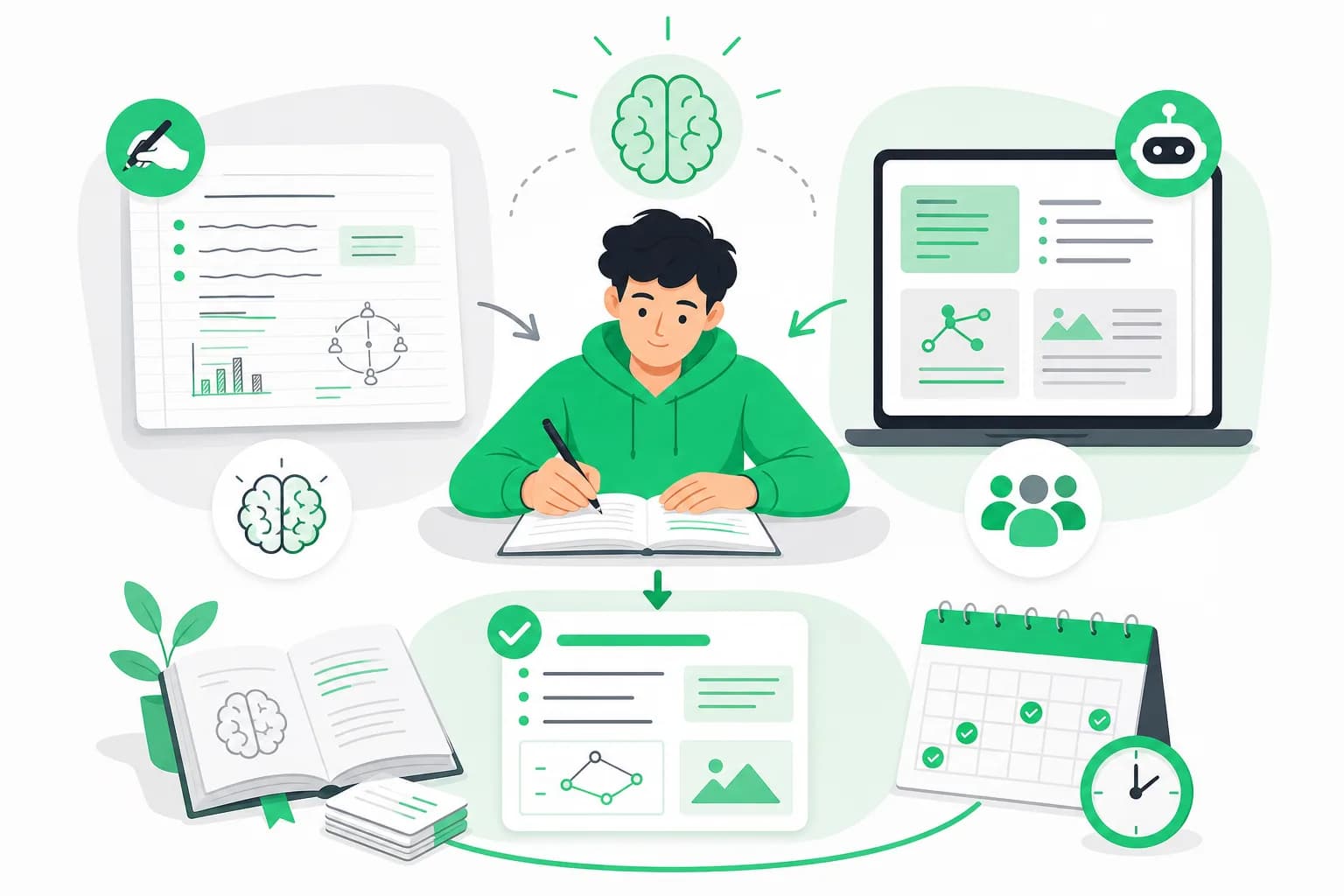
EduFiche users with the best results do not choose one OR the other. They combine them:
Phase 1 — AI: quick generation of a structured sheet from the lesson (30 sec).
Phase 2 — Manual: critical rereading, handwritten margin notes, adding personal mnemonics (15-20 min). This phase partly replaces the effect of manually making the sheet.
Phase 3 — AI: generating flashcards and quizzes from the validated sheet (30 sec).
Phase 4 — Manual: regular active testing (self-testing by hand on a blank sheet, the Feynman method out loud, diagrams redrawn from memory).
This loop gives each step a clear role: AI prepares a draft, critical review checks it against the course and active tests train memory. Time savings vary with document length, source quality and the corrections required, so measure them on one chapter rather than trusting a universal percentage.
Depending on your profile
High school student with plenty of time: keep a substantial amount of handwritten synthesis and practice because the exams are handwritten.
Overloaded student (prep school, university with a job, BTS in work-study): automate more of the formatting, but keep manual checking and exercises.
Competitive exam student (medicine, agrégation, selective schools): adapt the split to the exam; past papers and corrections remain central.
Career changer / self-learner: use AI for the first structure, then verify professional vocabulary and official sources.
Student in a very visual subject (anatomy, geology, engineering): redraw diagrams from memory and reserve AI for textual summaries or questions.
The trap to avoid in both cases
The pretty-sheet trap. Manual or AI, a study sheet is worthless if you do not use it actively afterward. Making it is the easy step. Memorizing it is the step that earns points. Do not fall in love with your beautiful multicolored sheets or your well-structured AI sheets — beauty has no effect on long-term memory.
The all-passive AI trap. If you upload, read for 30 seconds, and close it — you learned nothing. The manual validation phase is non-negotiable.
The all-manual trap under pressure. If you leave for Easter vacation with 200 pages of lessons not yet digested and decide to do everything by hand, you will burn out after 4 days. Be pragmatic.
Go further
- The complete guide to AI revision sheets
- How to make an effective study sheet in 2026 — the step-by-step method
- Top 7 best AIs to generate study sheets in 2026
- Why use AI to revise
Create your first AI study sheet for free — you can see for yourself whether the hybrid approach suits you.