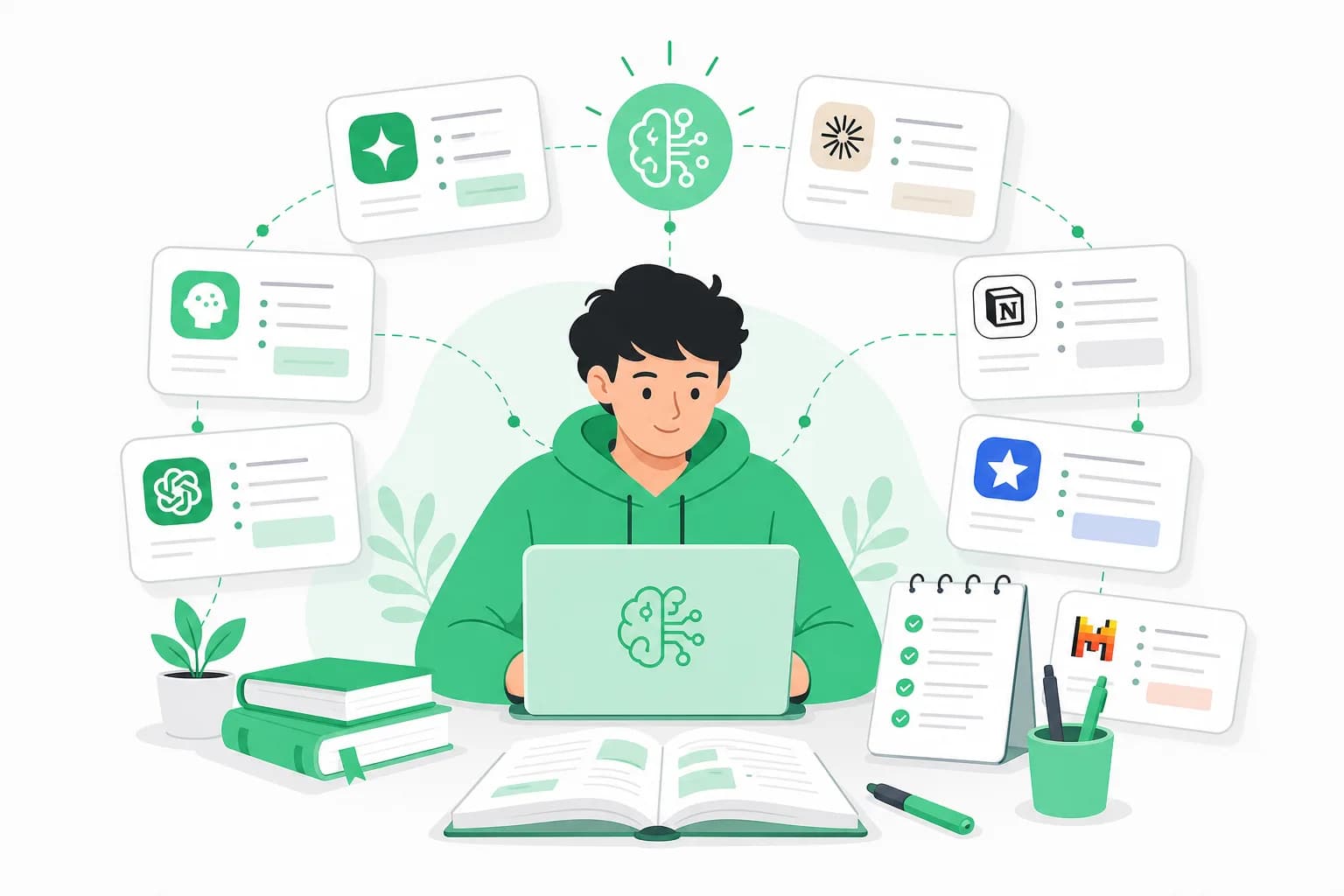

Top 7 best AI tools for study notes in 2026
The gap between AI tools for revision widened in 2026. We saw the arrival of excellent specialists (NotebookLM on Google’s side, Claude on Anthropic’s side), vertical solutions for students (EduFiche, and a few apps we won’t name because they produce hallucinatory content), and the rapid evolution of big general-purpose tools (ChatGPT, Gemini, Mistral).
The goal of this article: sort out what really works for turning a course into a clean study note, versus what takes so many prompts that you might as well do everything by hand.
Full disclosure: I’m the founder of EduFiche. I rank EduFiche #1 because I built it for this exact use case. If you doubt it, look at the criteria I use; they are the same for every tool. And read the Notion AI or ChatGPT sections too — you’ll see they’re objective about their limits and their strengths.
The 5 criteria that distinguish a good AI tool for study notes
Before comparing, let’s agree on what matters:
- Course fidelity: does the AI invent things your teacher never said? This is criterion #1 and it eliminates 80% of tools. A good AI stays grounded in your documents (RAG — Retrieval-Augmented Generation), it does not go fishing for information on the internet.
- Note structure: title, outline, definitions, examples, formulas — not a wall of text.
- Extra features: spaced-repetition flashcards, auto-generated quizzes, mock exam mode.
- Native language quality: academic French is more demanding than you might think (specialized vocabulary, register). An AI translated from English gives you “study notes” that sound like ChatGPT-in-2023.
- Price and accessibility: a €30/month tool is not viable for a student. The ideal: a free trial with no credit card and an affordable tier.
1. EduFiche
TL;DR: the most complete French-language solution, grounded in your documents, designed exclusively for French students.
EduFiche takes your raw course materials (PDF, Word, photos of a whiteboard) and generates a structured note + flashcards + quiz in 30 seconds, all grounded in your document via RAG. No hallucinations, no “the AI made up a formula” — the output rewrites what’s in your course, period.
What sets it apart in 2026:
- Mock exam mode: you choose a coefficient and a time limit, and the AI generates a sample exam
- Integrated spaced-repetition flashcards (similar algorithm to Anki)
- Strong command of French academic vocabulary (BTS, university, prépa)
- Mobile app (PWA) that works offline
Honest limits:
- No native desktop app (web and PWA only)
- Not ideal for very visual subjects (anatomy, geology) where you need to redraw diagrams by hand
- The AI stays faithful to the course — so if your course is poorly taken, the note will be too (garbage in, garbage out)
Price: free trial with no card. Student plan at €9.99/month for unlimited use. Premium plan with exam mode and unlimited flashcards.
For whom: any French-speaking student from middle school to university (and BTS / BUT / prépa). For the full method, see the complete AI study note guide.
2. NotebookLM (Google)
TL;DR: the serious general-purpose challenger, especially since Google added Gemini 2 and the audio podcast mode.
NotebookLM is Google’s tool for turning sources (PDFs, YouTube videos, websites) into summary notes, audio podcasts between two AIs discussing the topic, and quizzes. Its big strength: it stays faithful to sources (native RAG), so there are few hallucinations.
What works well:
- Excellent synthesis of multiple sources (up to 50 documents per notebook)
- The “audio podcast” mode is impressive for revising while walking or running
- Detailed outline and timeline generation
- Free with a Google account
Limits:
- No spaced-repetition flashcard system
- Little customization for notes (format is imposed)
- The interface is in English; French outputs are decent but sometimes awkward
- Not specifically designed for French school curricula (BO 2019, etc.)
Price: free with a Google account. Paid NotebookLM Plus plan for higher limits.
For whom: master’s students, PhD students, or bilingual users who want a versatile, free tool. A very good complement to EduFiche for audio/video sources.
3. ChatGPT (with a good prompt)
TL;DR: flexible and powerful, but you need to prompt it properly and it will invent without mercy if you don’t rein it in.
ChatGPT (GPT-5 in 2026) remains the most-used general-purpose tool. With a good prompt, it generates decent-quality summary notes. The main issue: it eagerly fills the gaps in your course with information from its training, without warning you. For exact subjects (maths, law, medicine), that’s risky.
What works:
- Very good writing style
- Memory across conversations (since 2024)
- Multimodal: you can send it photos of your notes
- Code Interpreter plugin for charts
Limits:
- Frequent hallucinations on details (dates, formulas, numbers)
- No default RAG (unless you upload in “file” mode)
- No native flashcards or quiz — you have to ask every time
- €20/month for the Plus version, essential for serious features
Prompt that works well in 2026:
You are a demanding professor. Here is my course in [subject] at [level]. Generate a structured study note. Absolute rule: use ONLY the information present in this course. If a concept is missing, clearly mark it with [missing info] instead of inventing it. Format: title, 3-4 part outline, key definitions, formulas or exact quotes, conclusion in 5 points. [paste the course]
For whom: students who are comfortable with prompts and willing to reread the note critically to spot hallucinations.
4. Claude (Anthropic)
TL;DR: the best general-purpose AI for long documents in 2026. Fewer hallucinations than ChatGPT.
Claude (version 4.7 / 4.8 in 2026) has become the favorite of students in the humanities and law thanks to its ability to process long documents (up to several hundred pages) without losing the thread. Its tone is calmer, and its summaries are less likely to invent things.
What works:
- Huge context window (1M tokens) — give it your whole book, it digests it
- Less “fluff” than ChatGPT, more precision
- Very good academic French
- Excellent for essays and text commentary
Limits:
- No native flashcard / quiz feature
- Less feature-rich than ChatGPT (no Code Interpreter, etc.)
- €18/month for Claude Pro, essential for the context window
- Not specialized for school curricula
For whom: literature, law, philosophy, and history students who have long courses and want a faithful summary.
5. Notion AI
TL;DR: convenient if you already live in Notion; insufficient if you want a tool dedicated to revision.
Notion AI is the AI built into the Notion platform. It can summarize a page, generate outlines, and create study note templates. Its strength: everything stays in the same space as your class notes.
What works:
- Perfect integration if you already take your notes in Notion
- Community-shared study note templates
- Collaboration possible (study groups)
- Good French
Limits:
- No native flashcards (you need a plugin)
- No auto-generated quizzes
- Not suited to large PDF documents (you have to copy and paste)
- €10/month on top of the Notion subscription (so about €18/month total)
For whom: users already invested in Notion who want to add an AI layer to their existing system.
6. Quizlet AI
TL;DR: king of flashcards, but weaker for structured notes.
Quizlet was a pioneer of online flashcards. Its AI version (Q-Chat) automatically generates memory cards from a text and offers varied learning modes.
What works:
- THE best for spaced-repetition flashcards
- Huge community database (you can find almost anything)
- “Match” and “Test” modes are very effective for active memorization
- Excellent for foreign languages (vocabulary)
Limits:
- No generation of structured summary notes
- Q-Chat remains limited in the free tier
- Lots of ads without a subscription
- Premium at €35.99/year (reasonable but without huge added value)
For whom: students whose main need is memorization through flashcards, especially for languages.
7. Mistral (Le Chat)
TL;DR: the French open-source option; good quality, GDPR-native, but less polished than US competitors.
Mistral, the French gem, launched Le Chat with model quality that rivals GPT-4 on most benchmarks. It’s the “European sovereign” option for those who care about data.
What works:
- Hosted in Europe, GDPR-native compliance
- Competitive Mistral Large model
- Free to try, Pro plan at €14.99/month
- Very good French
Limits:
- Not specialized for revision
- No native flashcards / quiz
- Smaller ecosystem (few plugins)
- Limited memory across conversations
For whom: students attached to European digital sovereignty.
Summary comparison in 2026
| Tool | Notes | Flashcards | Quiz | Fidelity (RAG) | French | Price |
|---|---|---|---|---|---|---|
| EduFiche | ★★★★★ | ★★★★★ | ★★★★★ | ★★★★★ | native | €9.99/month |
| NotebookLM | ★★★★ | ★ | ★★★ | ★★★★★ | good | free |
| ChatGPT | ★★★ | ★ (manual) | ★ (manual) | ★★ | native | €20/month |
| Claude | ★★★★ | ★ (manual) | ★ (manual) | ★★★★ | native | €18/month |
| Notion AI | ★★★ | ★★ | ★ | ★★ | native | €10/month |
| Quizlet AI | ★★ | ★★★★★ | ★★★★ | ★★ | good | €35.99/year |
| Mistral | ★★★ | ★ | ★ | ★★ | native | €14.99/month |
How to use AI well for your study notes
Whatever the tool, follow these rules:
Always reread and correct. The AI note is a draft, not a finished product. Allow 15-20 minutes of rereading per chapter — that’s where you really absorb the content, and where you catch hallucinations.
Give exact context. “Generate a note” is vague. “Generate a constitutional law study note for first-year level at Université Paris-Saclay, on chapter IV-1 pasted below” produces a usable note.
Use flashcards with spaced repetition. A note you read 3 times, flashcards you do 30 times. Memory science (Roediger & Karpicke 2006) is clear: it’s active recall that sticks, not passive rereading.
Mix tools. EduFiche for the structured note + flashcards. ChatGPT or Claude to dig deeper into a specific point. Quizlet if you love community-style flashcards. No need to choose just one.
Don’t get trapped by convenience. Reading a well-made AI note feels so good that you think you’re revising. But that’s an illusion. Active revision (self-testing, the Feynman method, exercises) is still mandatory.
To go further
- The complete AI study note guide — everything you need to get started properly
- How to make effective study notes with AI — the step-by-step method
- Manual notes vs AI notes: the comparison
- 5 effective memorization techniques for exams
Create your first AI study note for free on EduFiche — no credit card, note in 30 seconds, judge for yourself.