
Staying Focused While Studying: What Really Works
You know the scene. You sit down to study. You open your binder, take out your pens, and tell yourself, "okay, two hours of math." Thirty minutes later, you’re on Reddit reading a thread about the latest drama. You go back to math. You read a paragraph. Discord notification. You reply. You pick up again. A fly passes by. You watch it.
Welcome to modern student life.
Small confession before we start: I was never really a great student. Bac STI2D, a BUT in computer science in Bordeaux, and average grades as the only goal. I was never the person who studied eight hours a day — I was more the one who opened the lesson the night before the exam. So I’m not exactly in a position to lecture anyone about discipline.
That said, while building EduFiche, I talked with a lot of students who spend their lives revising, and I dug into what actually works for the ones who get by well (and for the ones who burn out). That’s what I’m bringing together here. Not a miracle guide — a filter between what changes something and what changes nothing.
The real problem isn’t concentration
People talk a lot about "attention deficit" in Gen Z, and that’s probably partly true. But when you can’t get yourself to work on your math chapter, the issue is almost never pure attention — it’s your nervous system regulating emotions.
You put off a task because it triggers something unpleasant: fear of not understanding, fear of failing, boredom, fatigue, frustration. Your brain, which dislikes discomfort, pushes you toward whatever relieves it right away — TikTok, the fridge, the news. That’s not laziness, it’s emotional avoidance behavior. This idea comes from Tim Pychyl’s work at Carleton University in Canada, where he has studied procrastination since the 1990s and published Solving the Procrastination Puzzle in 2013. Read it if you’re interested in the topic; it’s short and it gives you a bit of mental breathing room.
Why does this matter? Because it changes the strategy. You don’t need to "force yourself harder." You need to make the task emotionally bearable, and reduce the friction of getting started.
That’s it. Everything else flows from that.
Method 1: Pomodoro
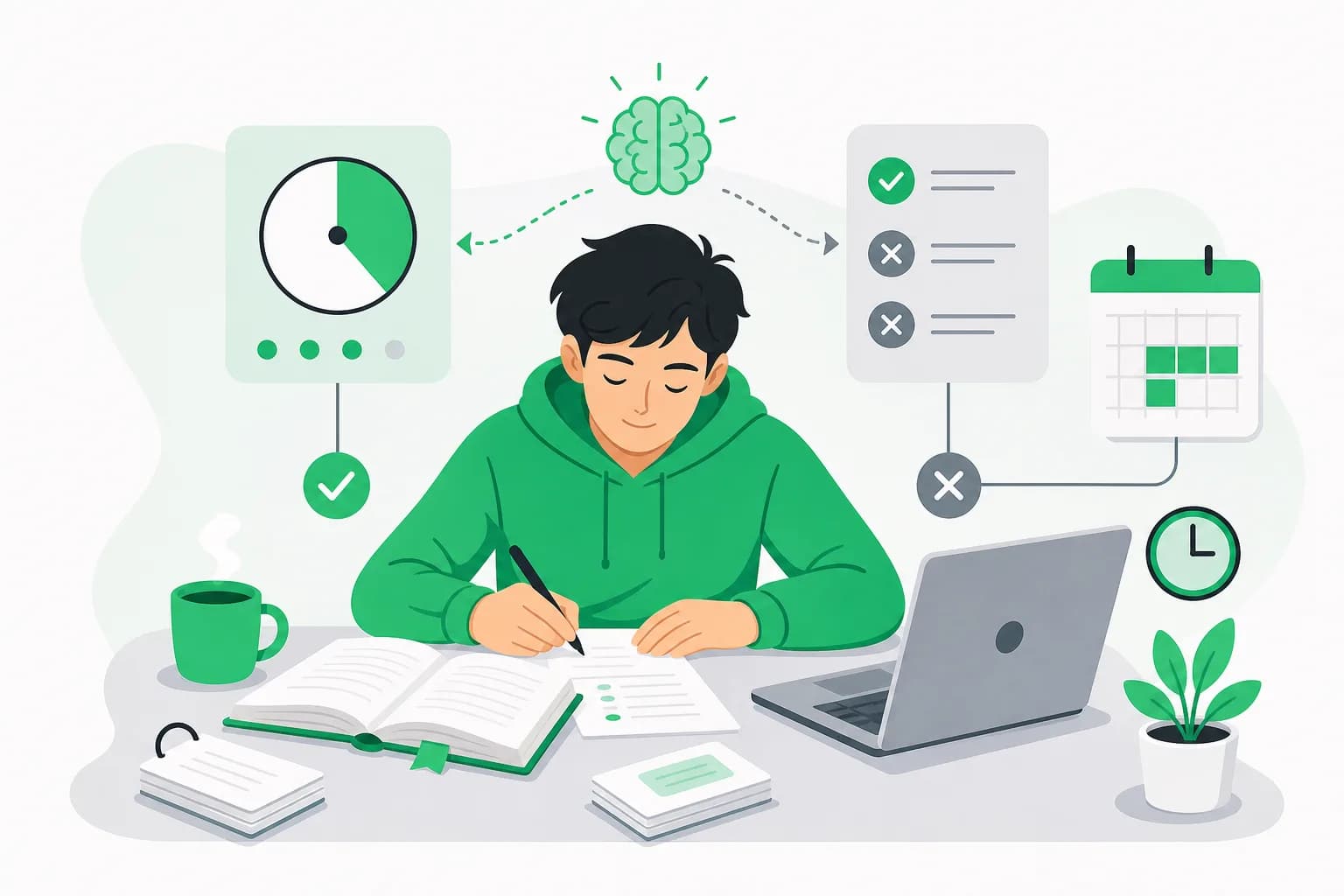
You know it: 25 minutes of work, 5 minutes of break, and after 4 cycles you take a longer break. A method invented by Francesco Cirillo in the 1980s, popularized among students around 2010.
What it works for: starting when you don’t want to start. The "I’m only signing up for 25 minutes" angle removes inertia. It’s psychological, but it works, especially for tasks you’ve been putting off for three days.
What it doesn’t work for: long essays, math proofs that require holding a line of reasoning for 90 minutes, creative writing. If you’re in the middle of a proof and the alarm cuts you off, you lose the thread and spend 15 minutes finding it again. That’s counterproductive.
My advice: use Pomodoro to kick off a work session, but stay free to switch into long mode once you’re underway. The trap is becoming a slave to the timer.
If you want a timer, get a physical one (a Time Timer, a kitchen tomodoro), not an app on your phone. Your phone is the enemy — we’ll get to that.
Method 2: time-blocking
The idea: you write your schedule for the next day the night before, blocking each time slot for a specific task. 9:00–10:30 math, 11:00–12:00 history, 2:00–3:30 English. You no longer decide anything during the day — you follow the plan.
Why it’s powerful: decision fatigue is real. Every time you ask yourself "what should I do now?", you burn cognitive energy. When everything is planned in advance, you save that energy for the work itself.
Cal Newport recommends this method in Deep Work (2016) and makes a point I think is spot on: it’s better to have an imperfect plan you follow 70% of the time than a perfect plan you throw away at the first unexpected event. You’ll misjudge durations at first. After two weeks, you’ll be roughly calibrated.
What trips people up: overloading the schedule. If you block 8 hours of work thinking you’ll hold that pace, you won’t, you’ll get discouraged, and you’ll abandon the method. Aim for 4 to 5 hours of effective work on a student day — that’s already very good.
Method 3: deep work
Cal Newport again. His thesis: the ability to focus without interruption on demanding cognitive tasks has become rare and valuable. He recommends sessions of 60 to 240 minutes with no interruptions at all.
It’s the most powerful method when it applies. A 90-minute uninterrupted session on a dense chapter is the equivalent of 3 hours of chopped-up work. Based on the feedback from EduFiche users that I see come through, that’s what separates the students who start slipping mid-semester from the ones who keep going — not the number of hours, but the quality of a few dense sessions.
Conditions for success, in order of importance:
The phone must be in another room. Not on airplane mode on your desk — the simple presence of the object reduces your cognitive abilities, and that’s documented (Adrian Ward et al., Brain Drain, 2017, Journal of the Association for Consumer Research). Your brain spends energy on not looking at it.
One single task announced to yourself out loud. If you want to do three things, you do three sessions.
A ritualized place and time. Always the same place, always the same time. In 10–15 days, your brain links the ritual with focus mode, and you get into it in less than 5 minutes instead of 25.
What makes deep work not applicable: class-prep timetables with classes all day long. You don’t have 90 consecutive minutes. In that case, do 45 minutes deep — that’s already much better than 90 minutes of fragmented Pomodoro.
The environment: 80% of the battle
No method survives a phone flashing every two minutes.
Gloria Mark at UC Irvine has been studying this for twenty years. Her most famous figure: on average, it takes 23 minutes to return to the initial level of attention after an interruption (study published in 2008, The Cost of Interrupted Work). That means a single notification every 20 minutes keeps dragging you back to zero concentration. In practice, you never actually concentrate.
So:
- Keep your phone out of reach. Not in the bag next to you. In another room, or in a locked drawer if you’re honest with yourself.
- Turn on "Do Not Disturb" on all your devices. Not silent mode — the mode that really cuts everything off.
- Use a site blocker during serious sessions. Cold Turkey or Freedom are the reference tools. Self Control if you’re on Mac.
- Keep your desk tidy, with only the essentials visible. Visual clutter also costs cognitive energy.
And one thing people forget: light and temperature. Concentration hits a wall in a room that’s too hot (above 24°C, cognitive performance drops, a Cornell study on office productivity, 2004). Open the window, sit near natural light, and don’t study with only your screen as a light source.
Anti-procrastination: what really works
Here’s what helps EduFiche users based on their feedback, and what I notice in everyday life when I have to work solo on the app.
The 2-minute rule (David Allen). If you feel procrastination creeping in, commit to just 2 minutes. Open the lesson, read the first page, write the first sentence. It’s no longer about the task — it’s only 2 minutes. The starting inertia drops, and 9 times out of 10 you keep going well beyond that.
The "non-zero day". Every day, at least 10 minutes of revision, even on days when you think "I’m exhausted, I’ll do everything tomorrow." It protects consistency. Once you’ve started, it’s rare to stop at 10 minutes — but you can. That’s the point. You break the cycle of "I haven’t done anything for 3 days, tomorrow will be worse."
Public commitment. Announce to your class group, or in a study Discord, "I’m doing 90 minutes of math now." The desire to keep your word is a powerful driver, and it costs nothing. The "body double" side of it — working on video next to someone who’s working, without talking — works very well too.
Immediate post-effort reward. Your brain expects a fast reward. The exam in 3 months is too far away to activate the dopaminergic circuit. Create micro-rewards: one episode of a series after 4 Pomodoros completed, a real outing on Friday if you followed your schedule. You teach your brain that effort = pleasure, not just effort = punishment.
What does NOT work, in what I see: positive visualizations like "you’re going to succeed, imagine your dream life when you have your diploma." It’s too abstract; it does nothing in the moment. By contrast, negative visualization in the Stoic style ("imagine the blank copy, the repeated year, your parents’ disappointment") is more effective for motivated but discouraged people. For others, it makes anxiety worse. Test it and see what works for you.
And what works for nobody: waking up at 5 a.m. to study. If you’re not a morning person, you’re not going to become one during your baccalaureate year. Adapt your method to your chronotype, not the other way around.
What EduFiche changes in practice
I’ll be honest: EduFiche is not a concentration app. What we do is remove the step that exhausts you and pushes you toward procrastination: turning lessons into study sheets.
When you get out of class, your brain is wiped out. If you also have to spend 2 hours rewriting everything neatly, highlighting, structuring — you’ll put it off. And then you’ll put it off again. After three weeks you have 80 pages of lessons not turned into study sheets, anxiety builds up, and you start avoiding your lessons out of stress.
What we do with the AI study sheet: you upload your raw lesson, we generate the structured sheet in 30 seconds. You spend 15 minutes rereading and correcting it (critical step, never skip it), and you immediately switch into active memorization mode. The phase that demotivated you no longer exists.
It’s not magic, it’s just an effort transfer: we remove the annoying part so you can focus on what actually gets you points — practicing, testing yourself, actively memorizing.
To go further
- How to make an effective study sheet with AI — the detailed how-to
- The 5 effective memorization techniques for exams — spaced repetition, memory palace, Feynman method
- How to build a study schedule that sticks
And if you want to get rid of the study-sheet bottleneck: you can generate your first AI study sheet for free. No bank card, just an uploaded lesson and a sheet in 30 seconds.
Good luck. Concentration is something you learn — it’s just that no one ever taught it to you at school.