

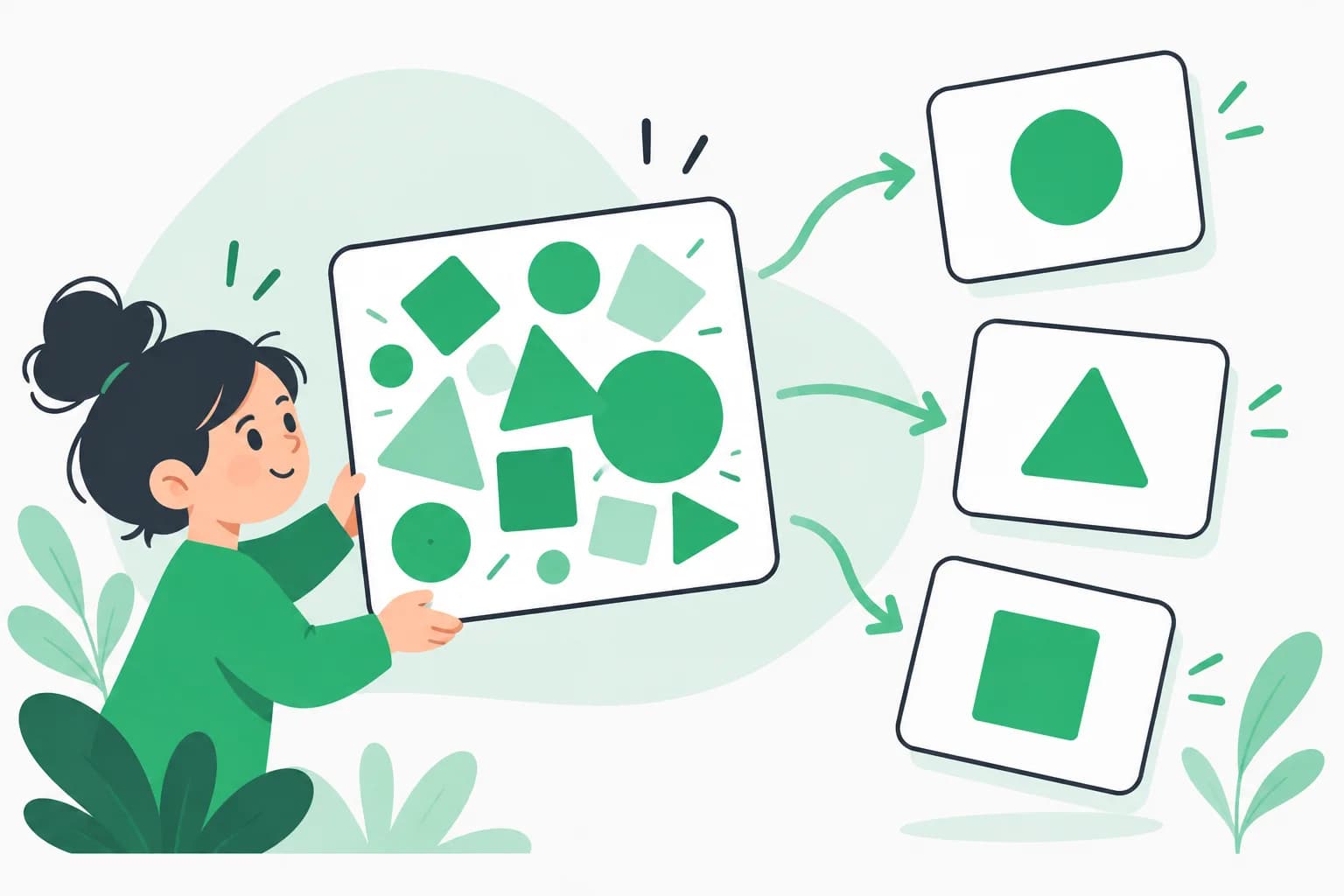

A good flashcard asks a question whose answer you can check. If it asks you to recite an entire chapter or allows a vague response, it tells you little about what you actually know. Before adding more cards, improve the questions.
Give each card a precise task
“Globalization” is a topic. “Give one example of a material flow studied in class and explain what is moving” calls for an identifiable answer. You then know exactly what to produce before you turn the card over.
For one concept, choose a definition, a distinction, a condition, or an application. If the answer includes several separate tasks, make several cards instead of one endless question.
You can then add a synthesis card that connects the ideas. Breaking recall into parts does not mean giving up on overall reasoning.
Write an answer you can correct
On the back, list the expected elements and, if useful, an alternative wording. The answer should let you decide whether your attempt covers the essential points.
Educational example: to distinguish two similar concepts, write the criterion that separates them and one example for each. Avoid a back side made of a copied paragraph with no hierarchy: you may end up judging your answer by feel.
The study by Karpicke and Blunt examines retrieval practice. A card helps organize that recall, but it does not guarantee mastery of a subject on its own.
Remove unintentional clues
A question can give away its answer through its length, a repeated phrase, or its place in a series. Reword it so it still makes sense outside its usual order.
Do not test a definition only with its first letter or an image that directly suggests the word. These clues can help at the start, but you should also check recall without them.
For generated cards, compare the question and answer with the course material. The CNIL notes the reliability limits of AI: a neatly worded answer can still be wrong.
Add application questions
After a definition, ask for a new example or a counterexample. After a formula, ask for the conditions that allow you to use it. After a distinction, give a situation to classify.
The EduFiche flashcards can give you a starting set. Review the cards and remove any that repeat the same task. A small useful set is better than a long set you cannot maintain.
Our guide on how to make a study sheet helps you choose which ideas to turn into cards.
Fix a card that keeps failing
If you fail, look at why: the concept is not understood, the question is ambiguous, the answer is too long, or there is a persistent confusion. Going back to the course may be more useful than immediately repeating the same card.
Rewrite weak questions before adding them to spaced repetition. Keep the conditions and important nuances.
Take five cards from your latest chapter. For each one, check that the instruction is precise, the answer is easy to grade, and any unnecessary clues have been removed. Then answer before turning the card over immediately.